Sign In
You may use social logins for more fluid experience.
Don't have an account? Create an account

Sign Up
You may use social logins for more fluid experience.
Already have an account? Sign in
Specific titles or studio names help distinguish between different content creators or series within a larger industry. Digital Archiving and Metadata
In the context of digital libraries, metadata is the backbone of discoverability. By tagging content with specific dates and participant names, archives become searchable. This is particularly important for:
Using date-based strings acts as a digital catalog number, ensuring that the correct version of a file is retrieved among millions of similar entries.
The landscape of modern search engines is defined by the use of "long-tail keywords." These are highly specific search terms that allow users to find precise entries within vast digital archives. A query containing a series of names, numbers, and dates often indicates a search for a specific piece of media, a news report, or a documented event indexed in a database. The Mechanics of Specific Search Terms
When a search query includes strings like dates (e.g., "21 11 06") alongside specific names or brands, it serves several functions:
Names of individuals or organizations act as primary identifiers, allowing search algorithms to narrow down the subject matter.
Content creators use these specific strings to ensure their work reaches its intended audience through search engines and specialized platforms. The Significance of Long-Tail Keywords
For public figures or performers, specific dates allow for the tracking of their professional history and career evolution.
The shift from broad terms to highly specific queries reflects a more sophisticated internet user base. Instead of searching for a general topic, users now input granular data to bypass irrelevant information and navigate directly to the desired record. This precision highlights the intersection of brand loyalty, archival science, and the meticulous nature of digital indexing.
Understanding these patterns is useful for anyone interested in how information is categorized, stored, and retrieved in the digital age.
Using our rewriter tool to rewrite texts is very easy and simple. All you have to do is follow the three steps mentioned below:

Copy-paste (CTRL + V) text or upload the file from your device.

Select your required mode.

Click the "Rewrite Article" button to rewrite the article.
Our advanced algorithm rewrites articles without altering their sense or general idea. This AI rewriter tool gives plagiarism-free content with enhanced readability in just a few clicks.
You can check the results given by our article rewriter using any plagiarism checker. The results will come back 100% unique.
It can help you rewrite content for blog posts, academics, and marketing by improving the content’s vocabulary. The interface is convenient to use for first-time users with easy to operate options and features.
Here's a list of advanced features of this paragraph rewriter:
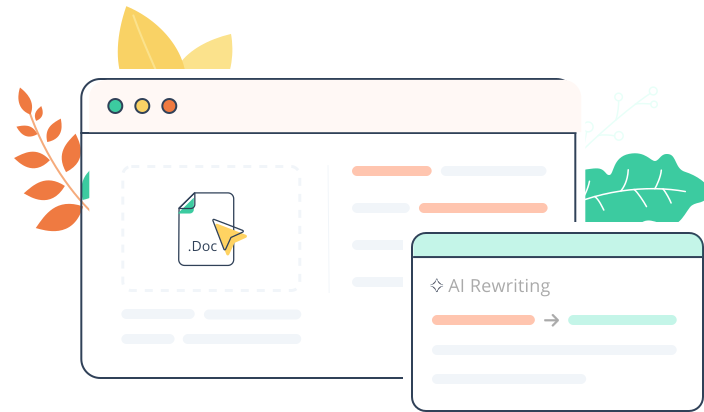
This AI-based sentence rewriter tool uses advanced technology to rewrite each sentence and gives you better options. You just have to upload content, and it will rewrite it automatically with one click.
This free article rewriter is simple to use. With just a few clicks, users can generate unique content that's free of duplicate content. You can rewrite articles on the go without having to register.
The outputs provided by our online paragraph rewriter tool are free from grammatical errors and spelling mistakes. Thanks to the smart AI working, even if there are grammar errors in your input, they will be eliminated when the text is rewritten.
Using an Article Rewriter can make life easier. This prevents inefficiency and unnecessary delays. Users can get the results within seconds with this online sentence rewriter.
| ✒️ Quickly Rewrites | Sentences, Paragraphs, & Essays |
| 🤩 Improves | Writing, Readability, & Vocabulary |
| 💡 AI Modes | 5 Distinctive AI Modes |
| 💰 Pricing | Free (& Paid) |
| 🌏 Multilingual | Supports up to 10 Languages |
Our article rewriting tool comes with five different modes – all of which have a different working. Let’s take a look at each mode in detail:

The Word Changer mode of our essay rewriter is made to target only words in the input text and replace them with their synonyms. It does not change sentence formation or the structure of the overall content. It is best for learning new words and for making light changes to the text.

The Sentence Rewriter mode is made to rewrite sentences of the given text. It alters the structure of the sentences. It can make changes such as converting passive voice into active and replacing phrases with concise words.

The Plagiarism Remover mode of our text rewriter can be used to rewrite text and make it plagiarism-free. If you have any plagiarism in your writing that you need to eliminate, you can use this mode to make the content unique and original.

The AI Rewriter mode utilizes advanced AI algorithms to understand the meaning and context of the given text. With this mode, our article rewriter is able to make heavy changes to the text without altering its original meaning.

The Paragraph Rewriter mode is programmed to make changes at a paragraph level. In other words, it rewrites the content paragraph by paragraph. The mode utilizes AI as well, and it makes smart changes without changing the intent of the text.
Specific titles or studio names help distinguish between different content creators or series within a larger industry. Digital Archiving and Metadata
In the context of digital libraries, metadata is the backbone of discoverability. By tagging content with specific dates and participant names, archives become searchable. This is particularly important for:
Using date-based strings acts as a digital catalog number, ensuring that the correct version of a file is retrieved among millions of similar entries.
The landscape of modern search engines is defined by the use of "long-tail keywords." These are highly specific search terms that allow users to find precise entries within vast digital archives. A query containing a series of names, numbers, and dates often indicates a search for a specific piece of media, a news report, or a documented event indexed in a database. The Mechanics of Specific Search Terms
When a search query includes strings like dates (e.g., "21 11 06") alongside specific names or brands, it serves several functions:
Names of individuals or organizations act as primary identifiers, allowing search algorithms to narrow down the subject matter.
Content creators use these specific strings to ensure their work reaches its intended audience through search engines and specialized platforms. The Significance of Long-Tail Keywords
For public figures or performers, specific dates allow for the tracking of their professional history and career evolution.
The shift from broad terms to highly specific queries reflects a more sophisticated internet user base. Instead of searching for a general topic, users now input granular data to bypass irrelevant information and navigate directly to the desired record. This precision highlights the intersection of brand loyalty, archival science, and the meticulous nature of digital indexing.
Understanding these patterns is useful for anyone interested in how information is categorized, stored, and retrieved in the digital age.
By comparing results, speed, word count limit, different modes and ease of use, the article rewriter by Articlerewriter.net is the best rewriting tool available online. It's 100% free to use with no daily limits.
Article rewriters are used for changing words and for helping in your own research. As far as such uses go, these tools are legal to use. But it is always advised to cite the source of the original content if you happen to borrow some.
Our text rewriter makes your content 100% plagiarism-free, So, the newly generated content is yours. You won’t have to worry about copyright infringement. If you want to copy research material directly, then cite the sources.
The importance of rewriting is in every field. It is important for the following reasons:
You can rewrite an article without changing the meaning by replacing the original words with synonyms, altering the sentence structures, breaking and merging sentences and shuffling the order of the content. You can also try our text rewriter to do all of these steps in a single click.
 ARTICLE
REWRITER
ARTICLE
REWRITER
It is easy to create website content by rewriting content. Our website, Article Rewriter, is here to rewrite content on your behalf with ease and speed.