Originally written: 3/14/2012; last Web page update: 3/13/2020, referencing rEFInd 0.12.0
This Web page is provided free of charge and with no annoying outside ads; however, I did take time to prepare it, and Web hosting does cost money. If you find this Web page useful, please consider making a small donation to help keep this site up and running. Thanks!
| Donate $1.00 | Donate $2.50 | Donate $5.00 | Donate $10.00 | Donate $20.00 | Donate another value |
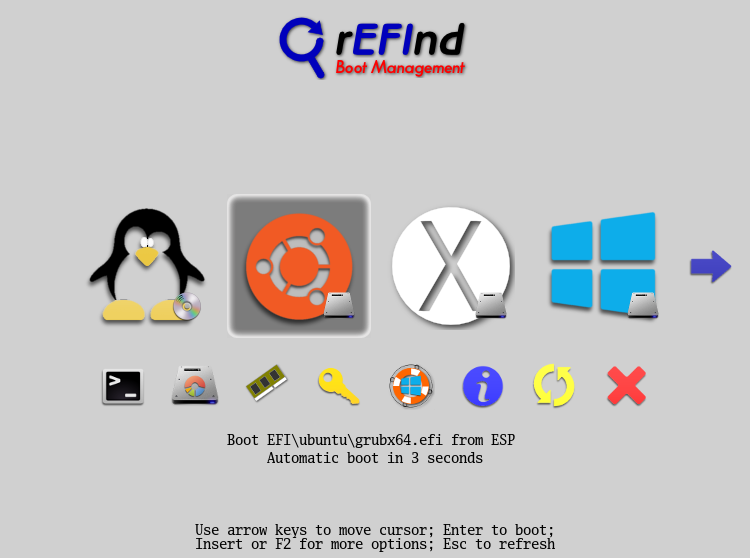
This page describes rEFInd, my fork of the rEFIt boot manager for computers based on the Extensible Firmware Interface (EFI) and Unified EFI (UEFI). Like rEFIt, rEFInd is a boot manager, meaning that it presents a menu of options to the user when the computer first starts up, as shown below. rEFInd is not a boot loader, which is a program that loads an OS kernel and hands off control to it. (Since version 3.3.0, the Linux kernel has included a built-in boot loader, though, so this distinction is rather artificial these days, at least for Linux.) Many popular boot managers, such as the Grand Unified Bootloader (GRUB), are also boot loaders, which can blur the distinction in many users' minds. All EFI-capable OSes include boot loaders, so this limitation isn't a problem. If you're using Linux, you should be aware that several EFI boot loaders are available, so choosing between them can be a challenge. In fact, the Linux kernel can function as an EFI boot loader for itself, which gives rEFInd characteristics similar to a boot loader for Linux. See my Web page on this topic for more information.
: This modifier narrows the search results to devices hosted on Indian IP addresses or associated with Indian domains. Why These Results Appear
Google Dorking: An Introduction for Cybersecurity Professionals inurl view index.shtml india
: This operator tells Google to find URLs containing this exact path. This file structure is the default web interface for many older or misconfigured AXIS IP cameras. : This modifier narrows the search results to
This specific search query is a known " Google Dork "—an advanced search string used to locate unsecured web-based interfaces, typically related to . When paired with "India," it targets devices specifically located within that region. Understanding the Query This specific search query is a known "
When a network camera is connected to the internet without a password or proper firewall settings, search engine crawlers like Google can "index" the page. To a crawler, the camera's live feed interface looks like any other webpage, so it adds it to its searchable database. Security and Ethical Implications
copyright © 2012–2020 by Roderick W. Smith
This document is licensed under the terms of the GNU Free Documentation License (FDL), version 1.3.
If you have problems with or comments about this Web page, please e-mail me at Thanks.
Return to my main Web page.