Purebasic — Decompiler
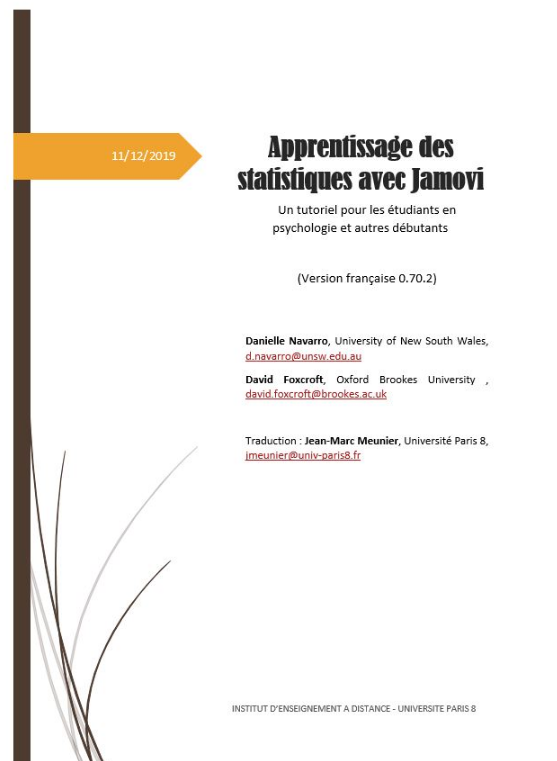
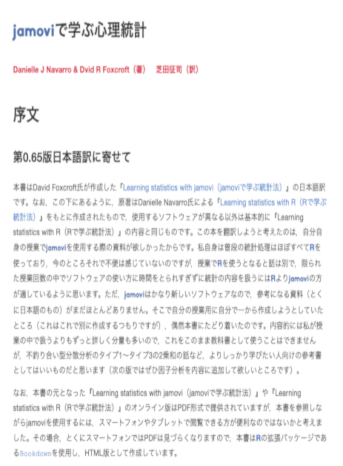
Danielle J. Navarro and David R. Foxcroft, Learning Statistics with jamovi: A Tutorial for Beginners in Statistical Analysis. Cambridge, UK: Open Book Publishers, 2025, https://doi.org/10.11647/OBP.0333
Read for freeDanielle J. Navarro and David R. Foxcroft, Learning Statistics with jamovi: A Tutorial for Beginners in Statistical Analysis. Cambridge, UK: Open Book Publishers, 2025, https://doi.org/10.11647/OBP.0333
Read for freeLearning statistics with jamovi covers the contents of an introductory statistics class, as typically taught to undergraduate psychology students.
The book discusses how to get started in jamovi as well as giving an introduction to data manipulation.
Written in latex and published as a pdf file, for great design and easy access.

Descriptive statistics and graphing are followed by chapters on probability theory, sampling and estimation, and null hypothesis testing.
The book covers the analysis of contingency tables, correlation, t-tests, regression, ANOVA and factor analysis.
The book is open source licensed and is free to access and/or download.
Hex Editors: For small changes, like bypassing a version check or changing a string, a hex editor is often more effective than a full decompiler.
Decompiler Plugins: Some experimental plugins for IDA Pro attempt to map known PureBasic signatures, helping to label functions that would otherwise be anonymous. The Ethics of Decompilation
However, "decompilation" in this context usually refers to three distinct levels of reverse engineering: purebasic decompiler
PureBasic presents specific hurdles for reverse engineers. Because the language is so efficient, there is very little "bloat" to analyze. Unlike languages that carry heavy runtimes, a PureBasic executable is "all muscle."
Software development is often a one-way street. You write high-level code, click "compile," and the compiler translates your logic into a dense thicket of machine code. For users of PureBasic—a powerful, cross-platform language known for producing tiny, lightning-fast executables—the question of going backward often arises. Whether it is for recovering lost source code, auditing a suspicious file, or learning how a specific feature was implemented, the hunt for a PureBasic decompiler is a common journey in the programming community. Hex Editors: For small changes, like bypassing a
If you have lost your .pb source files, the hard truth is that a "PureBasic decompiler" won't give you your comments, variable names, or clean structure back. You will likely spend more time deciphering assembly code than it would take to rewrite the logic from scratch.
Pattern Recognition: Advanced decompilers attempt to recognize standard PureBasic library calls. Because PureBasic uses a specific set of internal libraries for things like OpenWindow() or MessageRequester() , a smart tool can identify these patterns and "guess" what the original command was. Challenges Specific to PureBasic Because the language is so efficient, there is
The Enigma of Reverse Engineering: Is a True PureBasic Decompiler Possible?
During this process, "metadata" is stripped away. Variable names like UserAccountBalance are replaced with memory addresses. Loop structures like For/Next are converted into a series of CMP (compare) and JMP (jump) instructions. By the time the EXE is created, the original human-readable logic is gone, leaving behind a streamlined machine-code version of the original intent. The Reality of Decompilation